Queer Places:
Wellesley College (Seven Sisters), 106 Central St, Wellesley, MA 02481
Cornell University (Ivy League), 410 Thurston Ave, Ithaca, NY 14850
University of Göttingen, Wilhelmsplatz 1, 37073 Göttingen, Germany
Princeton Cemetery, 29 Greenview Ave, Princeton, NJ 08540, United States
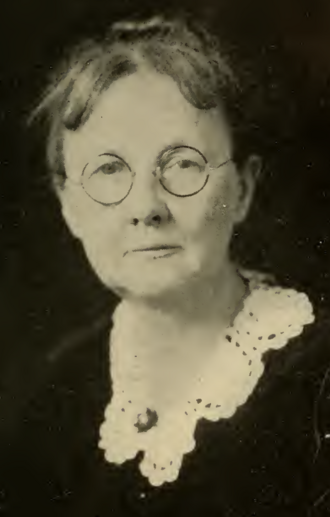 Eleanor Acheson McCulloch Gamble (March 2, 1868 - August 30, 1933) was born in Cincinnati, Ohio, on March 2, 1868, to Joseph Gamble and Mary McGill
Gamble, and grew up with a rich academic heritage as the granddaughter of the Reverend Dr. Alexander T. McGill of the Princeton Theological Seminary.
Despite being born with amblyopia in her left eye—and later developing glaucoma in her right eye that progressively worsened through her adult life
despite multiple surgeries—she forged a brilliant path in American psychology. She graduated from Wellesley College with her bachelor's degree in 1889
and went on to earn her Ph.D. from Cornell University in 1898 under the mentorship of Edward B. Titchener, writing her doctoral thesis on the
applicability of Weber's law to smell.
Eleanor Acheson McCulloch Gamble (March 2, 1868 - August 30, 1933) was born in Cincinnati, Ohio, on March 2, 1868, to Joseph Gamble and Mary McGill
Gamble, and grew up with a rich academic heritage as the granddaughter of the Reverend Dr. Alexander T. McGill of the Princeton Theological Seminary.
Despite being born with amblyopia in her left eye—and later developing glaucoma in her right eye that progressively worsened through her adult life
despite multiple surgeries—she forged a brilliant path in American psychology. She graduated from Wellesley College with her bachelor's degree in 1889
and went on to earn her Ph.D. from Cornell University in 1898 under the mentorship of Edward B. Titchener, writing her doctoral thesis on the
applicability of Weber's law to smell.
Following short teaching stints in Ohio and New York, Gamble returned to her alma mater in 1898 to join the philosophy and psychology department at
Wellesley College. She specialized in experimental psychology, was appointed associate professor in 1903, and received a postdoctoral research grant to
study under Georg Elias Müller in Göttingen, Germany, during the 1906–1907 academic year. Upon her return, she assumed direction of the Wellesley
psychological laboratory and was promoted to full professor in 1910. A respected leader in her field, she was an active member of the American
Psychological Association, the American Philosophical Association, Sigma Xi, and Phi Beta Kappa. Following the death of her close colleague
Mary Whiton Calkins in 1930, Gamble succeeded her as the head of the Department of Philosophy and
Psychology, overseeing research and teaching until the end of her life.
Within the context of early 20th-century academia, particularly during her prominent faculty tenure at Wellesley College between 1900 and 1910, Gamble
navigated a professional sphere deeply shaped by networks of highly educated, professional women. Wellesley, like many Seven Sisters colleges of that
era, served as a vital institutional home for pioneering female scholars. Many academic women of this generation formed primary domestic and professional
partnerships with other women—often referred to as "Boston marriages"—providing mutual support systems that enabled them to sustain demanding careers in
higher education. While historical records directly detailing Gamble's private romantic life are sparse, her life and career were structurally embedded
in this pioneering cohort of female academics who redefined women's roles in science and higher education.
Gamble maintained her academic and leadership duties despite near-complete blindness later in life. She passed away at the age of 65 on
August 30, 1933, at the Ipswich Hospital after falling ill while attending a religious retreat at Adelynrood in South Byfield, Massachusetts. Her funeral
services were held at Adelynrood, and she was buried in the Princeton Cemetery in New Jersey. Remembered as a dedicated mentor, brilliant researcher, and
beloved teacher, her legacy at Wellesley was honored in June 1939 with the dedication of a commemorative stained-glass chapel window gifted by her 1889
graduating class, featuring symbols of wisdom and her deep affection for animals.
References:
Other references:
- Ruckmick, Christian A. (1934). "Eleanor Acheson McCulloch Gamble." The American Journal of Psychology, 46(1), 154–156. (An essential contemporary obituary and academic tribute detailing her life, career, and contributions to experimental psychology).
- Fancher, Raymond E., & Rutherford, Alexandra (2017). Pioneers of Psychology. W. W. Norton & Company. (Includes contextual analysis of early women in American psychology, featuring profile coverage of Gamble).
- Proctor, Robert W., & Evans, Rand B. (2014). "E. B. Titchener, Women Psychologists, and the Experimentalists." The American Journal of Psychology, 127(4), 501–526. (Explores her doctoral training under Titchener at Cornell and her inclusion in early elite experimental psychology circles).
- Gamble, E. A. McC. (1898). "The Applicability of Weber's Law to Smell." The American Journal of Psychology, 10(1), 82–142. (Her foundational doctoral dissertation).
- Gamble, E. A. McC. (1902). "The Perception of Sound Direction as a Conscious Process." Psychological Review, 9(4), 357–373.
- Gamble, E. A. McC. (1905). "Attention and Thoracic Breathing." The American Journal of Psychology, 16(3), 261–292.
- Gamble, E. A. McC. (1909). "Minor Studies from the Psychological Laboratory of Wellesley College: Intensity as a Criterion in Estimating the Distance of Sounds." Psychological Review, 16(6), 416–426.
- Gamble, E. A. McC. (1915). "A Defense of Psychology as Science of Selves." Psychological Bulletin, 12(5), 194–202. (Reflecting her academic engagement with the philosophical perspectives of Mary Whiton Calkins).
- Gamble, E. A. McC., & Wilson, L. (1916). "A Study in Spatial Associations in Learning and in Recall." The Psychological Monographs, 22(4), 40–97.
- Wellesley College Archives: Holds administrative records, faculty files, correspondence (such as communications involving departmental transitions and campus buildings), and historical materials concerning the Department of Philosophy and Psychology during her tenure and leadership under Calkins and Gamble.
- Wellesley College Chapel Stained Glass Windows Documentation: Institutional records detailing the commissioning and June 17, 1939 dedication of the chapel window gifted by the Class of 1889 in honor of Eleanor Gamble.
Support this project
This website is a passion project researched, developed, and funded entirely by me. If you find the content valuable and would like to help support the ongoing research and hosting costs, any contribution is deeply appreciated.
Thank you for keeping this independent resource alive!
My books on Amazon: Elisa Rolle's books
BACK TO HOME PAGE
